


Sunny Days Blog
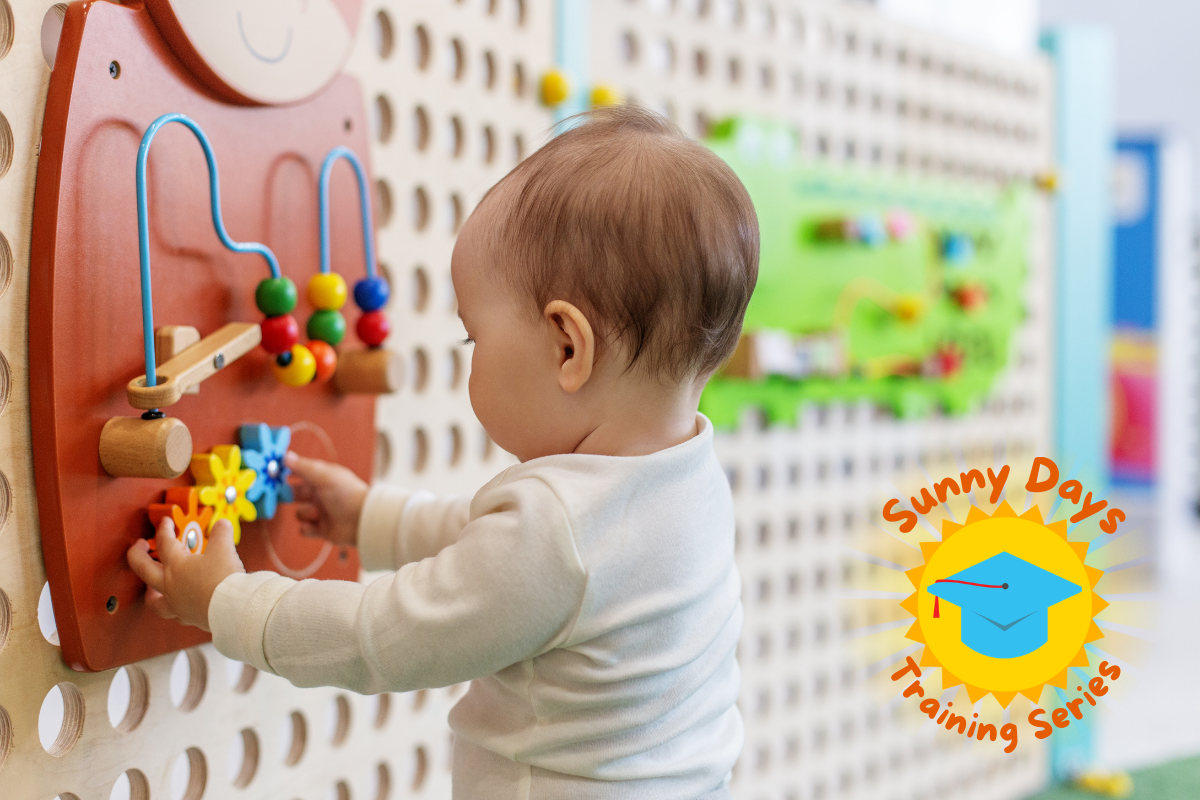
Children who are referred for early intervention services are evaluated using a standardized developmental assessment to determine their eligibility for services, and to help identify their respective strengths and needs. These evaluations help parents, caregivers, and practitioners work as a team to identify goals and outcomes for the child and family. These goals and outcomes regularly focus on targeting skills and behaviors that address both family priorities and concerns, while fostering the child's development.
Commonly Targeted Early Childhood Development Skills
We evaluate many developmental skills and milestones when we determine a child's needs and strengths. These include skills that help young children engage with parents and caregivers, abilities that enable infants and toddlers to communicate wants and needs, imitation skills, identification skills, motor skills, and self-regulation skills.
Skills that help infants and toddlers engage with caregivers:
- Responding to caregivers’ vocalizations and actions
- Reciprocating engagement
Skills that allow toddlers to communicate their wants and needs:
- Gesturing, reaching and/or pointing for desired items or activities
- Vocalizing with imitated words and sounds
- Using word approximations
- Using singular words or short phrases to request or respond to others
- Using sign language, picture-assisted communication strategies, or other modalities
Imitation skills:
- Imitating others' actions
- Imitating vocalizations
Skills that target discrimination and responding to others:
- Identifying people, objects, body parts, and actions
- By showing
- By saying
- Following simple directions
Motor Skills:
- Crawling, cruising, walking, and navigating the environment
- Fine motor skills related manipulating toys, utensils, and everyday objects
Coping Skills and Self-Regulation:
- Accepting short durations of delayed gratification/waiting
- Accepting less-preferred scenarios – nail trimmings, diaper changes, tooth-brushing
- Transitioning between activities
Acquiring these foundational early learner skills helps infants and toddlers grow and prepare for future learning. These skills can usually be taught via naturally-occurring play scenarios and everyday experiences:
-
Activities as simple as “Peek-a-Boo” can help foster connectivity and social referencing.
-
Singing songs like “Wheels on the Bus” can help with discrimination and imitation skills.
-
Placing favorite items in-sight, but out-of-reach can help motivate a child to gesture or point to request.
When a child is not developing and progressing as desired, it is imperative for clinicians, parents, and caregivers to understand all of the skills behind these abilities so we can more effectively troubleshoot any difficulties with skill acquisition and more comprehensively assist in our children’s development.
Putting it into Practice: Assessing Prerequisite Developmental Skills
All of the early learner skills noted above have often-overlooked prerequisite skills and abilities that need to be in place in order for acquisition and mastery to occur. These prerequisite skills can be categorized into cognitive, motor, and sensory abilities (including perceptual and attending skills):
-
Cognitive skills and abilities include understanding the environment, how to respond, and the ability to produce the response.
- Motor skill prerequisites include having the ability to plan and execute the necessary physical components of a skill or behavior.
-
Sensorial/attentional/perceptual abilities refer to the infant/toddler’s ability to identify, attend to, and process the relevant information in the environment.
To better illustrate this, let’s look at a common early learner skill and identify the required prerequisite abilities for skill mastery.
Skill: Responding to one’s name with eye contact
Cognitive Prerequisites:- Identifying one’s name amid other auditory stimuli
- Understanding the expectations when responding to one’s name by providing eye-contact/visually engaging the speaker
- Joint attention: implicit understanding that the activity/moment is shared
- Planning and executing the physical actions to look at the speaker
- Maintaining balance
- Orienting to the speaker
- Stamina required to sustain visual attention
- Figure-ground processing: the ability to hear to one’s name being called and “push” competing stimuli to the background
- Locating the speaker
- Shifting attention from self to the speaker
- Stamina for maintaining attention on relevant stimuli
- Coping skills for ceasing immediate action and responding to others
When we can identify the abilities that contribute to cognitive, motor, and sensory skills, we can identify the child’s developmental strengths and needs. This allows us to better understand and more comprehensively address the individual needs of each child and help us set a more solid foundation for present and future learning, growth, and development.
For all our Sunny Days practitioners, Scott Rieger offers online trainings on early childhood skill assessment and more. We hope you join us for a future webinar!
For more tips on early childhood development, be sure to follow us on Instagram, Facebook, LinkedIn, and X. Please contact us if you have concerns regarding your infant or toddler's development milestones.